THREE DOTS OVER TAURUS-LITTROW, A RED OBJECT NEXT TO SKYLAB AND A TUMBLING ROD: THE NASA PHOTOS IN THE PENTAGON'S UFO ARCHIVE
The PURSUE archive includes NASA photographs from Apollo 12, Apollo 17 and Space Shuttle mission STS-80, and the Skylab crews' reports of a mysterious reddish object. The Department of War has even opened a new case on an Apollo 17 photo. We looked at every image.
Most of the NASA material in the Department of War's PURSUE archive is text and audio. But it also includes photographs: five from Apollo 12, one from Apollo 17 and three from the Space Shuttle. It also includes the Skylab crews' account of an object that was never identified for them. We examined every image at full resolution.
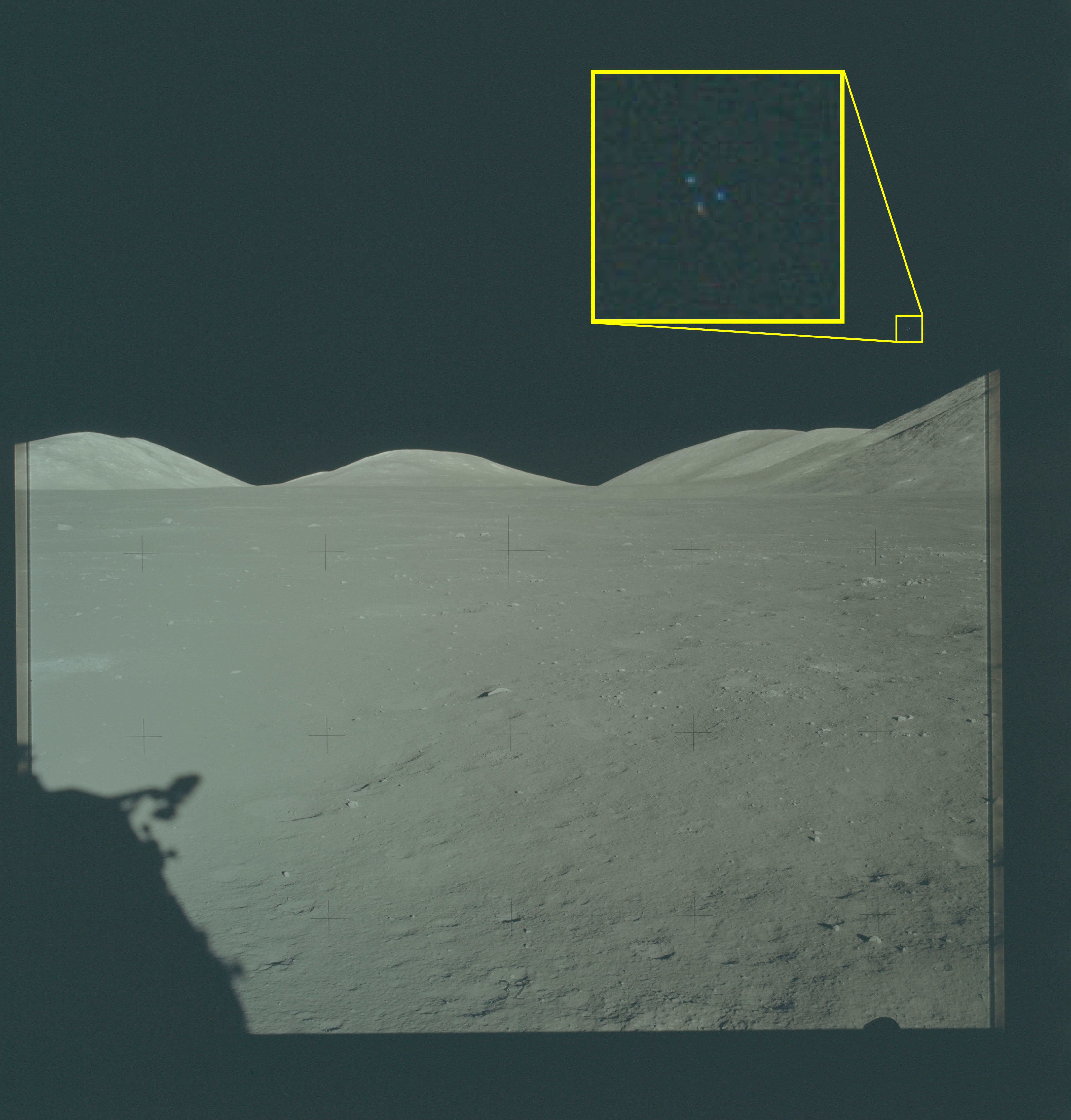
Apollo 17: an open Department of War case (NASA-UAP-VM006)
Source: NASA / U.S. Department of War, PURSUE UAP archive (war.gov/UFO).
This is the most intriguing image in the NASA set. It is a December 1972 photograph of the Taurus-Littrow valley, with the massifs on the horizon and a large shadow of the lunar module or rover in the foreground. A yellow box added by the archive magnifies a small area of black sky above the right-hand massif. It shows three small soft dots in a triangle: two blue-cyan dots side by side and an orange one below.
The official description is unusual. The Department of War says it "has opened a case to investigate" the photo. It says there is "no consensus about the nature of the anomaly", and that new preliminary U.S. government analysis suggests the feature is "potentially the result of a physical object in the scene". It also says the government has obtained the original Apollo 17 film, and that the full NASA and Department of War analysis will be published when completed.
What we can see: each dot is only a few pixels wide, fuzzy and without structure. Film defects, dust or reflections are the usual suspects in such cases, but the government says it is still analyzing the original film. We will follow the case.
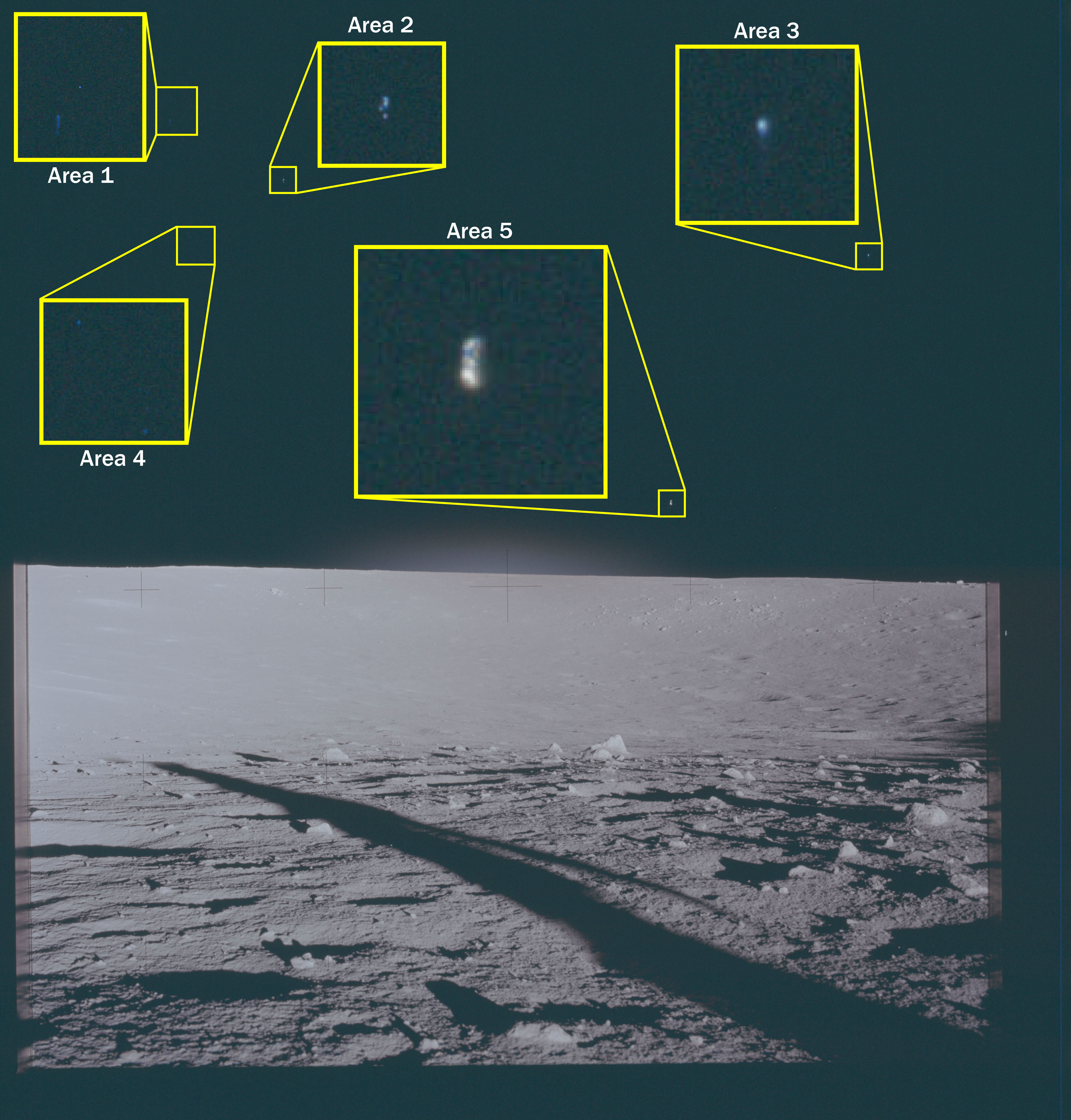
Apollo 12: highlighted "areas of interest" (VM001–VM005)
Source: NASA / U.S. Department of War, PURSUE UAP archive (war.gov/UFO).
Five photographs taken on the lunar surface by the Apollo 12 astronauts in November 1969 come with yellow boxes over "areas of interest" in the sky. The astronauts' long shadows appear in several of them. When magnified, the "phenomena" are tiny blue or color-fringed specks. The most visible is a white-blue blob made of two or three stacked lobes in "Area 5" of VM005. The archive includes a clear disclaimer: the images "have been modified" to help viewers, and the highlights "do not constitute an analytical judgment, investigative conclusion, or factual determination". The sky has been brightened, which also brings out film grain.
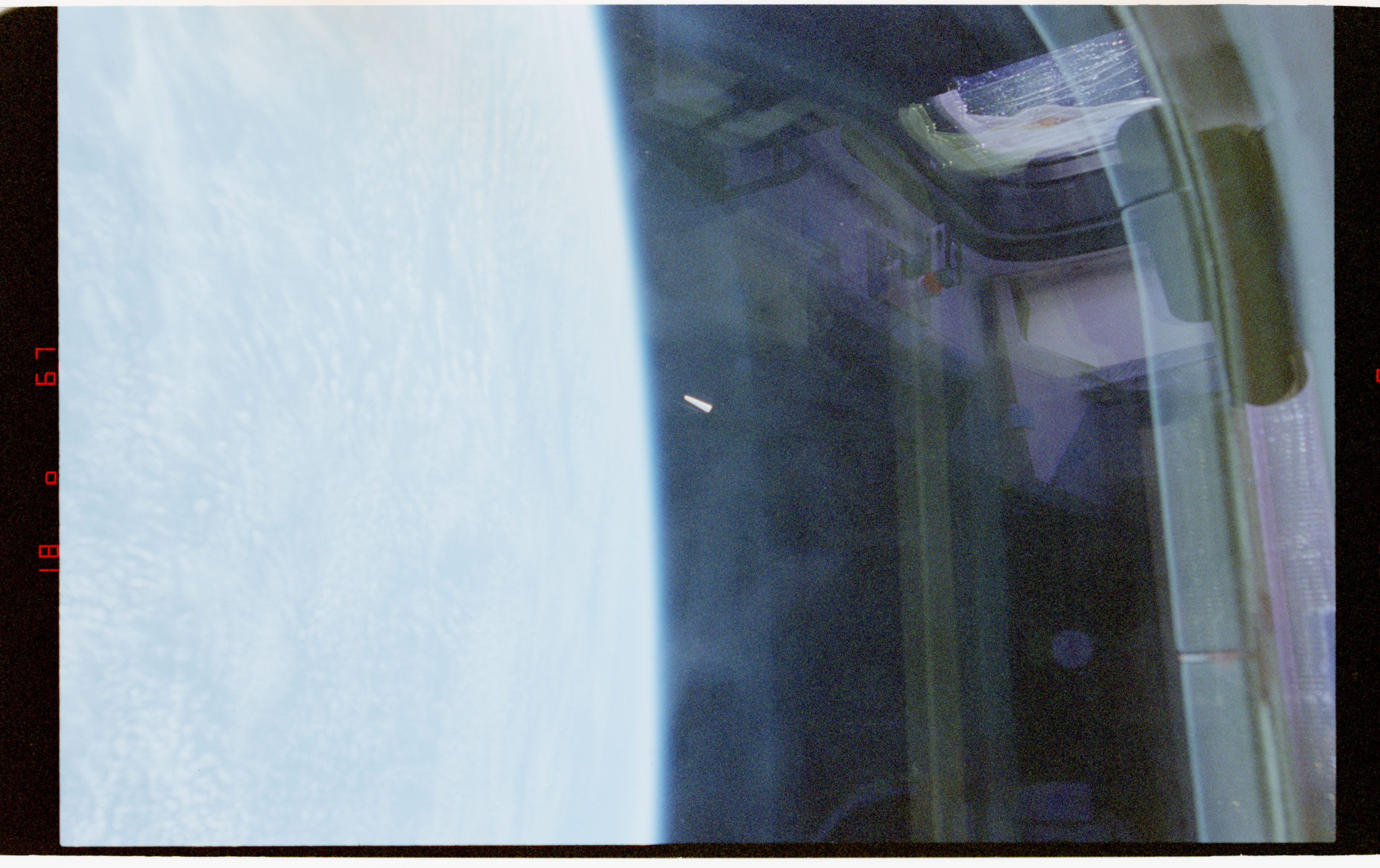
STS-80, 1996: a tumbling rod (D030–D032)
Source: NASA / U.S. Department of War, PURSUE UAP archive (war.gov/UFO).
During mission STS-80 of the Space Shuttle Columbia (November–December 1996), the crew photographed an unidentified object three times through a window:
- Image 1: near the Earth's limb, a small, sharp, bright white elongated object, like a rod or cylinder, slightly tapered.
- Image 2: the same object, now shorter and wedge-shaped, as if seen end-on. The archive says it "appears to have rotated or tumbled about its major axis, which is consistent with the behavior of a free-floating object".
- Image 3: the object against the clouds, "along a trajectory passing between Columbia and the Earth".
Reflections of the cabin interior are visible in the glass. Nothing suggests lights or propulsion: it looks like a small piece of tumbling hardware. The archive itself describes it in those terms but gives no identification.
Skylab 3: a reddish object "no one ever explained to us" (D007)
The Skylab crew debriefings (1973–1974) contain one of the most interesting unresolved observations in the NASA set. About a week before splashdown, the Skylab 3 crew of Alan Bean, Owen Garriott and Jack Lousma tracked "this bright reddish object" for 5–10 minutes:
- It was "much brighter than Jupiter or any of the other planets", and reddish even well above the horizon.
- It rotated, with a brightness period of "almost exactly 10 seconds".
- It entered Earth's shadow 5–7 seconds after Skylab, so the crew estimated it was not more than 30 to 50 nautical miles away, in an orbit very close to their own.
- Bean: "we could never make it into anything other than a bright light."
Garriott called it "obviously a satellite", but asked: "What satellite it was and how it happened to end up in such a similar orbit, no one ever explained to us. And I would like to hear a few words from someone about that satellite." The released document contains no answer.
The other Skylab crews reported light flashes with their eyes closed ("They're not an hallucination", said Joseph Kerwin), and flashing lights outside that they "presumed… were other pieces of Skylab, or possibly other satellites".
What the NASA images tell us
- Apollo 17 VM006 is the only NASA image the Department of War presents as an open investigation, with "preliminary" analysis and the original film in hand. It is worth watching.
- The Apollo 12 highlights are explicitly not analytical findings, and the specks are at the limit of film grain.
- The STS-80 object behaves like tumbling debris, and the archive's own wording points that way.
- Skylab 3's red object remains, in the documents, a nearby satellite that no one identified.
All images and documents can be viewed on the official portal: WAR.GOV/UFO – NASA files.
This article is part of our series on the NASA files in the PURSUE archive.